The Human-Environment Systems, Interactions, Impacts, and Intelligence (HESI) Lab
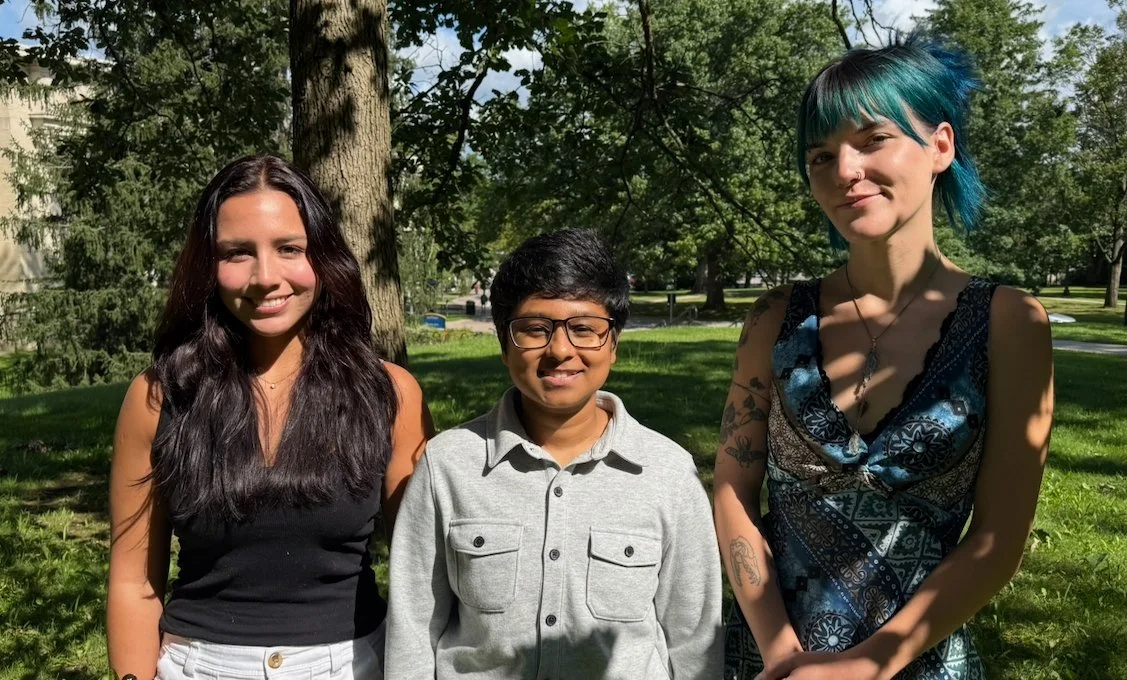
Members of our Graduate Research Lab, as of Fall 2026. Left-to-right: Domenica Robles, Sinthia Silvi, Anna Penkalski
Our team
The Human-Environment Systems, Interactions, Impacts, and Intelligence (HESI) Lab is made up of PhD, Master’s, and undergraduate students interested in working on complex socio-environmental issues. Our research focuses on applying spatial modeling, simulation, and scenario analysis to investigate how land use practices, governance structures, and environmental change influence water quality and social-ecological resilience, with the goal of supporting adaptive management strategies. While we specialize in quantitative approaches, we also recognize the pressing socio-environmental issues of our time cannot be fully addressed by a single methodology or even discipline. Accordingly, our work employs a range of methods to answer policy-relevant research questions.
Current students
Sinthia Silvi is a PhD student in Geography at Kent State University. Her research uses GeoAI, remote sensing, geostatistics, and machine learning to study environmental and hazard-related problems. Her current work focuses on detecting animal feeding operations (AFOs) in the Chesapeake Bay Watershed and understanding manure-related risks to water quality. Before joining Kent State, Sinthia earned her MS in Geography from Ohio University, where she worked on spatial modeling of PM2.5. She holds a BSc in Geography and Environment from Jahangirnagar University, Bangladesh, where her undergraduate research used remote sensing to study drought.
Domenica Robles is a master's student in the Department of Geography at Kent State University. Her research is part of the HABRI-funded project Aligning People, Policy, and Water: Social-Ecological Dimensions of Wetland Restoration in the Great Black Swamp Region, where she is conducting interviews and focus groups with farmers, SWCD staff, and conservation organizations across the Western Lake Erie Basin. Trained as an agronomist, Domenica previously worked hands-on with agricultural producers in Costa Rica, an experience that moved her interest from the technical side of conservation toward the social processes that determine whether it happens at all.
Anna Penkalski is a master’s student in the Department of Geography at Kent State University and a researcher in the HESI Lab. Her research contributes to the HABRI-funded project on the social-ecological dimensions of wetland restoration in Ohio’s Western Lake Erie Basin. She is interested in water resources and the relationships between human communities and natural systems, integrating quantitative and qualitative approaches to examine these interactions. Anna earned her B.A. degrees in Geography and Environmental Studies, with a minor in Biology for Environmental Conservation and Management from Kent State University.
Lab Alums
Kwang-il (Jason) Yoo earned his PhD in Geography from Kent State University in 2026. His dissertation, "GeoAI for Coupled Human and Natural Systems: Multi-scale Water Governance in Chesapeake Bay Watershed," applied GeoAI and machine learning to multi-scale water governance and BMP planning in the Chesapeake Bay watershed. He also built web-based geovisualization tools for environmental and public-health data. Jason is currently a Visiting Professor of Geography at Ohio University.
Uzma Jabeen earned her PhD in Geography from Kent State University in 2026. Her dissertation, "Assessing Regional Profiles of Social Vulnerability to Coastal Flooding in The Chesapeake Bay Region: Sensitivity of Vulnerability Profiles to Spatial and Temporal Variation and Flood Exposure Metrics," examined social vulnerability to coastal inundation in the Chesapeake Bay region, drawing on her background in environmental science and integrated water resources management and her earlier work in community vulnerability and disaster management in Pakistan. As a Fulbright Fellow, Uzma has returned to Pakistan and plans to work continue her work on vulnerability in her home country.
Emmi Berski earned her MA in Geography from UNL in May, 2024. Her master’s thesis research surveyed municipal planners to assess motivations and barriers to green infrastructure usage, concerns about climate change, perceptions of public opinion, and green infrastructure implementation in cities across the Midwest. Through this research, she investigated the relationship between planners’ perceptions of public climate change opinion and the strength of their motivations in developing green infrastructure regulations.
If you are interested in working with us
First, read our code of conduct and working expectations here.
A large part of success in graduate school comes down to “fit” among students, advisors, and the program. To help gauge whether our lab might be the right fit for you, I encourage you to review my CV and to read a few of my publications found here. The more closely our interests align, I will be better able to advise, mentor, and guide you towards success in graduate school. If you think our interests fit well, great! Send an email and we can start a conversation.
Funding and applying to graduate school
Funding for graduate studies at Kent State is competitive, with many of our students funded by teaching assistantships. Occasionally I will have openings for funded graduate research assistantships, which will be posted on this site and communicated via AAG and other appropriate listservs.
If you are interested in applying to the PhD or MA programs within the Geography Department at KSU, you can find the relevant details here. Applications are generally due in January, but please confirm with official sources. You are STRONGLY encouraged to reach out to potential advisors (e.g., me) via email prior to applying.
For undergraduate students
If you are a current undergraduate student interested in research, please contact me by email. We often have projects, many of which are funded, that can support your interests and growth.